
How to Market Your App a Founder's Practical Playbook
Discover how to market your app with our practical playbook. Learn ASO, audience building, and content strategies designed for founders and small teams.
You’ve poured your heart and soul into building something amazing. Now for the fun part: getting it into the hands of people who will love it.
The secret to marketing your app isn't some massive, one-time launch explosion. Forget that. Real, sustainable growth comes from a much simpler, more powerful idea: small, consistent actions, every single day. That’s what builds unstoppable momentum.
Your App Marketing Journey Starts Now
Think of this guide as your personal playbook. It’s built for founders like us, where every minute and every action has to count. We’re not going to waste time on abstract theories. Instead, we’ll build a simple system where one genuine community comment or one directory submission a day adds up to more than a complex, expensive campaign ever could.
Let's be real, the app market is booming. We're talking 218 billion downloads, a 7% jump from the year before. And it’s not slowing down. Forecasts are pointing towards 255 billion downloads soon. For a solo founder, that’s both a massive opportunity and a stark reminder that you're jumping into a crowded pool. You can see more data on the mobile app marketing landscape on amraandelma.com.
Building Momentum One Day at a Time
The core philosophy here is simple. Small wins, compounded daily, lead to massive results. As a founder, your time is everything. So, the goal is to create a marketing habit that feels manageable and actually rewarding—something that prevents the burnout that comes from trying to do everything at once.
This is about turning overwhelming goals into a concrete daily practice.
The secret to getting ahead is getting started. The secret of getting started is breaking your complex overwhelming tasks into small manageable tasks, and starting on the first one. - Mark Twain
Your daily marketing efforts will orbit around three key activities: getting your app listed on relevant platforms, genuinely engaging with potential users, and taking small steps that directly lead to more downloads.
It's a simple, repeatable cycle.
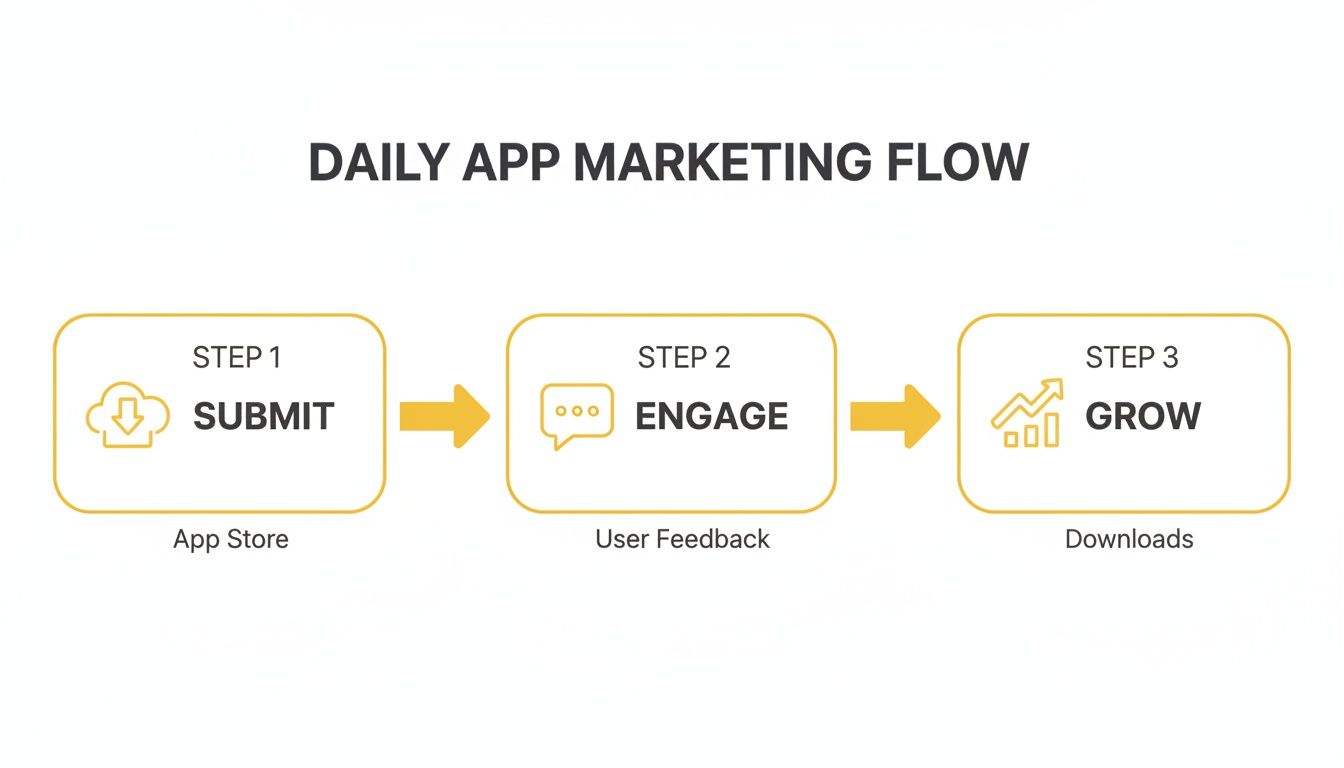
The real magic in this flow is how each action feeds the next. You submit your app, get feedback, engage with that feedback, and that engagement drives growth. It’s a self-reinforcing loop that trades sporadic, high-effort pushes for the reliable power of daily consistency.
And don't worry, we'll show you exactly how to do it. If you ever need a little push along the way, we’ve put together some great founder inspiration stories to keep you going.
Your Daily App Marketing Action Plan
To give you a clearer picture of what this looks like in practice, here’s a quick overview of the core daily marketing habits this playbook will help you build.
| Marketing Channel | Daily Action Example | Typical Time Commitment |
|---|---|---|
| Pre-Launch & ASO | Research and add 5 new keywords to your ASO tracking tool. | 15-20 minutes |
| Social & Content | Share one behind-the-scenes update on Twitter or LinkedIn. | 10-15 minutes |
| PR & Partnerships | Find and email one journalist or blogger in your niche. | 20-30 minutes |
| Community Engagement | Answer one relevant question on Reddit or Quora. | 15-20 minutes |
This table isn't meant to be a rigid schedule, but a guide. The goal is to build a rhythm that works for you, turning marketing from a daunting task into a simple, productive part of your day.
Build a Foundation with Positioning and ASO
Before you drop a single dollar on ads or spend hours chasing downloads, we need to get back to basics. It all boils down to two simple but powerful questions: Who is this for, and why on earth should they care?
Answering these isn't just a fluffy branding exercise. It's the concrete foundation for every marketing decision you'll make. Get this right, and everything else flows. Get it wrong, and you're just shouting into the void.
This journey starts by defining your Ideal Customer Profile (ICP). And I mean really defining it. Vague descriptions like "busy professionals" won't cut it. We need to get painfully specific. What industry are they in? What’s their actual job title? What’s the nagging, frustrating problem they deal with every day that your app was born to solve?
Let’s say you built a project management app. A weak persona is "small business owners." A strong ICP, on the other hand, is "solo freelance web designers struggling to manage client feedback and project timelines, who are constantly losing track of key revisions buried in endless email chains." See the difference? One is a faceless crowd; the other is a real person with a real problem you can fix.
Craft Your Unique Value Proposition
Once you know exactly who you're talking to, you can finally craft a message that hits home. Your Unique Value Proposition (UVP) is your promise. It’s a short, sharp statement that clearly explains the benefit you deliver, how you solve your customer's specific problem, and what makes you different from every other app out there.
Think of it as your elevator pitch. It’s not a laundry list of features; it's the promise of a better, easier, or more successful life.
A great UVP is a promise of value to be delivered. It's the primary reason a prospect should download your app over a competitor's. If your positioning is fuzzy, your marketing will be too.
A simple sentence can bring incredible clarity. Try filling this in: My app helps [your specific ICP] to [achieve a desired outcome] by [solving their core problem] unlike [your competitors]. This single sentence will become your north star, guiding everything from your app store copy to your social media bios.
Master App Store Optimization (ASO)
With your positioning dialed in, it’s time to weaponize it with powerful App Store Optimization (ASO). ASO is simply the art and science of getting your app seen in the app stores. Your app store page is your single most important salesperson—it has to be compelling, crystal clear, and incredibly persuasive.
This isn’t about just stuffing keywords into every available space. It’s about strategic storytelling that turns casual browsers into loyal users.
Key Elements of Winning ASO
- App Title and Subtitle: This is prime real estate for your most important keywords. Your title needs your brand name and your main keyword. "SleepWell AI Sleep Tracker" is infinitely better than just "SleepWell."
- Keywords: Both the App Store and Google Play give you a dedicated spot for keywords. Do your homework. Find out what your ideal customers are actually typing into that search bar. Spy on your competitors and use ASO tools to uncover high-traffic, low-competition gems.
- Description: The first few lines are everything. They must hook the reader and immediately state your UVP. Use the rest of the space to sell the benefits, not just list the features.
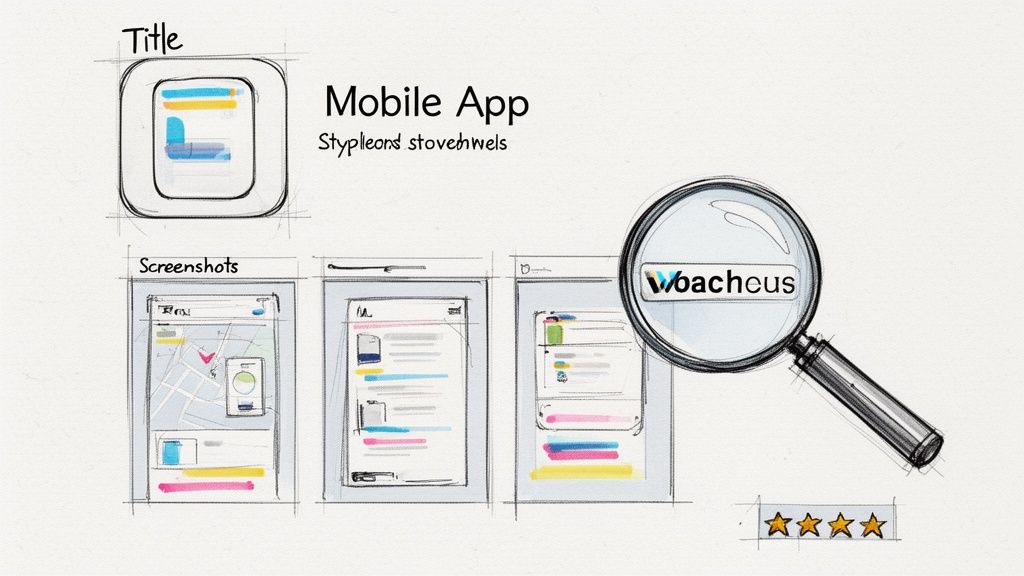
- Screenshots and Video: This is your chance to show, not just tell. Your first two screenshots are make-or-break. They need to tell a visual story that instantly communicates how your app solves the user's biggest pain point.
Turn Your App Page into a Conversion Machine
Please, don’t just upload random captures of your app’s interface. Your screenshots should be treated like tiny, curated billboards. Each one needs a powerful caption that hammers home a key benefit. Think of it as a mini-story that unfolds as the user swipes.
For that task management app we talked about, the visual story could be:
- "Capture tasks in a flash" (showing a clean, simple input screen).
- "Finally organize your day" (displaying a beautifully prioritized to-do list).
- "Never miss a deadline again" (highlighting a smart notification).
This strategic approach to ASO isn’t a one-and-done task. It’s a daily habit. Spend 15 minutes a day researching a new keyword, tweaking a line in your description, or mocking up a better screenshot. These small, consistent improvements will compound over time, giving you a massive advantage.
For more ideas on where to get your app listed, check out our guide on the best directories for your startup.
Create a Waitlist of Eager First Users
The single biggest fear every founder has? Launching to the sound of crickets. All those hours poured into coding, designing, and dreaming, only to release your app into a silent void. This isn’t just a nightmare scenario; it’s a completely preventable mistake.
The antidote is simple: build your audience before you have a product to sell. A pre-launch waitlist is your first and most powerful marketing tool. It’s so much more than a list of emails—it's your tribe of early believers, a live focus group for your ideas, and a built-in army of day-one advocates. This is how you turn a launch from a coin toss into a calculated win.
Design a Simple Yet Irresistible Landing Page
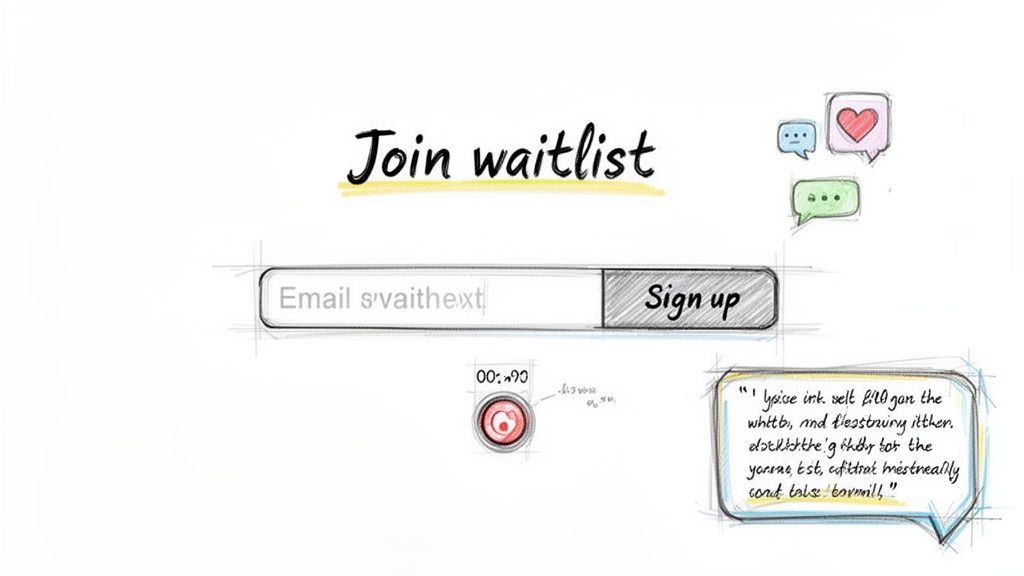
Your pre-launch landing page has one job, and one job only: convince a visitor to give you their email address. That's it. Don't overcomplicate it. We're not aiming for perfection here; we're aiming for connection.
To be effective, your page only needs a few key things. First up, a killer headline that grabs your ideal user by the collar. It needs to speak directly to their pain point, using the exact language you uncovered when you built your Ideal Customer Profile. Follow that with a punchy sub-headline that frames your app as the solution they’ve been looking for.
Next, add a few bullet points highlighting the top three benefits—not features—of your app. How will it make their life better? Will it save them time? Help them finally achieve a goal? And finally, you just need a crystal-clear call-to-action (CTA) button and a single email input field. Seriously, that’s all.
Pro Tip: Your CTA button text really matters. Ditch the generic "Subscribe" and try something that screams value, like "Get Early Access" or "Join the Beta." It immediately reframes the signup as an exclusive opportunity, not just another newsletter.
Remember, this page is your first impression. You can use a tool like Carrd or Webflow to get something clean and professional live in a few hours, not days.
Drive Early Traffic to Your Waitlist
Okay, your landing page is live. Now the real work begins. Your mission is to get that page in front of the right people. This doesn't require a big budget, just some strategic hustle in the places where your audience already hangs out.
The heart of effective pre-launch marketing is getting into the communities where your ideal customers are actively talking about their problems.
- Reddit: Find subreddits related to your app's niche. But please, don't just drop your link and run—that’s the fastest way to get banned and ignored. Instead, provide genuine value. Answer questions, share insights, and only mention your app when it’s a natural, helpful solution to someone’s problem.
- Indie Hackers & Niche Forums: These communities are packed with early adopters who genuinely love trying new products. Be transparent. Share your journey, ask for feedback on your idea, and talk about your progress. Authenticity is everything here.
- Build in Public on Twitter/X: Document your entire process. Share screenshots of new features, talk about the challenges you're hitting, and celebrate the small wins. This storytelling approach builds a following of people who become invested in your success.
The key is to act like a member of the community, not a marketer. Your goal isn't to sell; it's to build relationships and spark genuine curiosity.
Nurture Your List from Subscribers to Advocates
Getting that email is just the first step. The real magic is in how you communicate with your waitlist. A silent waitlist is a cold waitlist. You have to keep them engaged, excited, and feeling like they're part of an inner circle.
Plan on sending an update every one to two weeks. These emails don’t need to be long, formal essays. A simple, personal check-in is often the most powerful way to build a connection.
What to Include in Your Waitlist Emails:
- A Personal Hello: Start with a quick, authentic greeting. Let your personality shine through.
- Progress Update: Share a sneak peek of a new feature, a design mockup, or a milestone you’ve hit. Make it visual.
- Ask for Feedback: Involve them directly in the process. Ask for their opinion on an icon, a feature name, or a color scheme. People love to help build things.
- A Look Ahead: Briefly mention what you’re tackling next. This keeps the anticipation building and shows you have a plan.
This consistent, human communication transforms passive subscribers into an engaged community. By the time you’re ready to launch, they won’t just be users; they'll be your most passionate champions, ready to shout about your app from the rooftops. That's how you market your app before it even exists.
Find Your Voice with Content and Social Media
Content marketing is a marathon, not a sprint. For a solo founder, the sheer number of channels—blogs, Twitter, LinkedIn, TikTok—can feel completely paralyzing. But here’s the secret: you don't need to be everywhere. You just need to be incredibly magnetic in the few places that truly matter.
And the good news? You already have your single greatest marketing asset: your own authentic story.
Your journey building this app—the frustrating bugs, the late-night breakthroughs, the little "aha!" moments—is the most compelling content you'll ever create. This isn't about pretending you're a guru; it's about sharing the real, raw experience. This "build in public" approach is a game-changer for marketing your app, attracting people who become genuinely invested in your success.
You’re not just selling software; you’re inviting people into your world. That creates a level of trust and loyalty a faceless corporation could only dream of. Your voice is your unfair advantage.
Create Content That Solves Real Problems
The best content doesn't just ramble on about your app's features. It dives deep into the exact problems your ideal users are losing sleep over.
Think of your blog not as a sales brochure but as a library of genuinely helpful resources. Every single article should be a direct answer to a question your target customer is typing into Google right now.
Start by grabbing a notebook and brainstorming the top 10-15 pain points your app solves. Let's imagine you built a budgeting app for freelancers. All of a sudden, your blog topics become crystal clear:
- How to Actually Manage a Wildly Irregular Income
- My Simple System for Tracking Business Expenses (So You Don't Hate Tax Season)
- The 5 Most Common (and Costly) Tax Mistakes Freelancers Make
- A No-Nonsense Guide to Setting Your Freelance Rates with Confidence
When you write from this "helper" perspective, you stop "selling" and start "serving." That shift is everything. Each post becomes a little magnet, pulling in potential users who are actively searching for the solution you've built. It's a cornerstone of learning how to market your app for sustainable, long-term growth.
Master One Social Platform First
The urge to sign up for every social network is strong, but it's a trap. As a solo founder, your time is gold. Spreading yourself thin guarantees you'll make a weak impression everywhere instead of a powerful one somewhere. The goal is depth, not breadth.
So, where does your ideal customer hang out online? If you're targeting other B2B founders, LinkedIn and X (formerly Twitter) are probably your home turf. If your app is for photographers or interior designers, Instagram or Pinterest might be the perfect fit.
Pick one platform and go all-in. Commit to mastering it.
Your social media strategy can be dead simple: Show up consistently where your audience already is and provide real value every single time you post. Forget the algorithm hacks and just focus on authentic human connection.
Once you’ve chosen your channel, create a simple daily routine. It doesn't need to take more than 15-20 minutes. Pop in, engage with a few people, share a quick update, and reply to comments. Consistency beats intensity, every single time.
A Simple Daily Social Media Workflow
Having a repeatable plan takes the guesswork out of it all. It makes your social media efforts feel manageable, not like another soul-crushing chore on your to-do list.
Here’s a simple but incredibly effective daily routine you can adapt for your chosen platform:
- Engage First (5 minutes): Before you even think about posting, spend five minutes genuinely connecting with others. Reply to comments on your last post and drop thoughtful comments on 2-3 posts from other people in your niche. This shows you’re part of the community, not just a broadcaster shouting into the void.
- Share Your Story (5 minutes): Post your daily update. This could be anything—a screenshot of a new feature you're wrestling with, a quick thought about a challenge, or a small win you celebrated with a cup of coffee. Realness is magnetic.
- Provide Value (5 minutes): Go find one person asking a question you can answer. Help them out, with no strings attached. This builds incredible goodwill and establishes your expertise without ever feeling salesy.
That's it. This simple, three-step process, done daily, will build your presence and your network far more effectively than some massive, high-effort campaign you burn out on after a week. It turns marketing from a dreaded task into a sustainable habit. Your journey is what makes you unique—sharing it is the most powerful way to market your app and find your first true fans.
Pour Some Fuel on the Fire with Smart Partnerships
Organic growth is a beautiful thing, but eventually, you'll hit a ceiling. To break through, you need to pour a little fuel on the fire. For a solo founder or a small team, this doesn't mean you need a giant ad budget. It's about being clever and finding leverage—using small, focused efforts to get a massive return.
This is where smart acquisition and strategic partnerships come in. It’s all about finding ways to get in front of audiences that other people have already built. Forget about expensive, scattergun campaigns; we're talking about precise, high-impact collaborations that feel genuine.
Dip Your Toes in the Water with Small Paid Experiments
Before we jump into partnerships, let's have a quick chat about paid ads. It's a massive space—global spend has shot past $400 billion, and short-form video ads make up over 35% of that. You're not going to outspend the big players, but you can definitely use their sandbox to learn some incredibly valuable lessons. For more on this, check out these mobile app marketing statistics on strataigize.com.
The goal here isn't to get a flood of new users overnight. It's about learning. Think of it as cheap research. Platforms like Reddit and X (what used to be Twitter) are fantastic for running tiny, hyper-targeted ad experiments.
Your First Ad Campaign Playbook
- Set a Micro-Budget: Seriously, start with just $50-$100. You’re buying data, not world domination.
- Go Super-Niche: On Reddit, you can advertise directly to subreddits where your ideal customers are already hanging out. If you built a photo-editing app, you'd go straight to a community like r/photography.
- Test Your Story: Run a couple of different ads, each highlighting a different angle or benefit of your app. Does one headline get way more clicks? Does a certain feature seem to resonate more? The answers you get are pure gold.
This simple approach flips paid advertising on its head. It’s no longer a costly gamble; it's an affordable way to figure out what messaging actually works. The data you gather will make everything else—from your app store copy to your partnership pitches—so much sharper.
The True Force Multiplier: Partnership Marketing
Alright, now for the real magic: partnerships. I’ve seen a single, honest review from a creator drive more high-quality downloads than thousands of dollars in ads ever could. Your job is to find these people and build real, human connections with them.
Forget about blasting a generic email to a list of a hundred influencers. That's a waste of time. The secret is targeted, personalized outreach. We’re looking for micro-influencers and niche bloggers—people with smaller, but incredibly engaged and loyal audiences who hang on their every word.
A genuine endorsement from a passionate creator in your niche is the most powerful marketing you can get. It’s not an ad; it’s a trusted friend telling you about something cool they found. That kind of social proof is priceless.
Start by creating what I call a "dream 100" list. Who are the 100 people—bloggers, YouTubers, newsletter writers, podcasters—who are already talking to your perfect customer? Seriously, block out an afternoon and build this list. It's your new treasure map. Once you have it, you can start the slow and steady work of building relationships.
How to Write an Email That Actually Gets a Reply
Creators get buried in requests. Your email has to cut through the noise by showing you've actually done your homework and that you respect them and their audience. A little bit of personalization goes a very, very long way.
Here’s a simple email framework that just works:
- A Specific, Genuine Compliment: Kick things off by mentioning a specific piece of their content you truly enjoyed. "I loved your recent video on productivity tools for remote workers..." immediately shows you're a real fan, not a spambot.
- The Quick Intro: In one or two sentences, explain what your app is and who it's for. Crucially, connect it directly to something their audience cares about.
- The Easy "Ask": Don't just ask for a review. That feels transactional. Instead, offer them free, no-strings-attached access to your app. Frame it as a gift. "I'd love to give you a lifetime pro account on the house, just as a thank you for all the great content you create."
- The No-Pressure Close: End by making it crystal clear that there are zero obligations. This removes all the pressure and makes them far more likely to check it out.
This patient, relationship-first approach is how you turn strangers into true advocates for your app. Each partnership you build becomes a powerful new channel, sharing your story with an audience that's already eager to listen. If you're looking for more ideas on where to find these audiences, you might like our deep dive on effective marketing channels for startups.
Engineer Growth Through Retention and Measurement
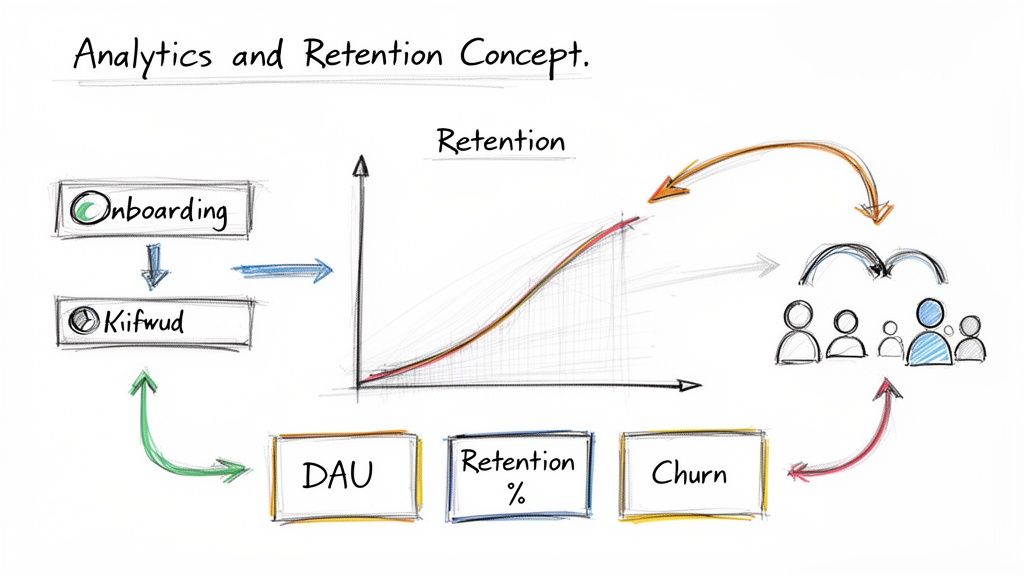
Getting someone to download your app isn't the finish line—it's the starting gun. The real victory, the part that actually builds a lasting business, is making them want to stay. Growth without retention is just a leaky bucket. You’ll burn through your time and money just trying to keep it from emptying out.
This is where your mindset has to shift from being a marketer to being a growth engineer. It’s about creating an experience that’s so genuinely useful, so sticky, that people can't imagine their lives without it. Real growth isn't just about getting downloads; it’s about becoming obsessed with the user's journey after they hit install.
Nail the First Five Minutes
Let's be blunt: your onboarding process is the single most important part of your entire app. It's your one and only chance to deliver on the promise you made in the app store. A confusing or clunky setup is the fastest way to lose a user for good. In fact, a single bad mobile experience makes users 88% less likely to ever come back.
Your goal is to get that user to their "aha!" moment as fast as humanly possible. This is that magical instant when they experience the core value of your app and think, "Oh, wow. This is exactly what I needed."
To get them there, your onboarding has to be laser-focused on one thing: guiding them to perform the single most important action. For a task manager, that’s creating their first to-do. For a photo editor, it’s applying their first filter. Cut out all the noise and get them to that one key action.
Forget the exhaustive product tour. Nobody cares about all your cool features yet. Your one and only mission during onboarding is to deliver a quick, meaningful win that makes the user feel smart and accomplished. That feeling is what brings them back.
Think about how you can build little feedback loops into the experience. A simple "Nice one!" message after they complete a key task or a small visual celebration can work wonders. It reinforces that they're doing it right and builds the momentum you need to turn them into a regular user.
Measure What Actually Moves the Needle
Analytics can feel like a black hole, full of vanity metrics that look good on a chart but tell you absolutely nothing about the health of your business. Let's forget about total downloads or sign-ups for a minute. If you want to really understand if your app is succeeding, you need to focus on a handful of KPIs that reflect genuine engagement.
These are the numbers that tell you if you're building something people truly love.
- Daily Active Users (DAU): This is the heartbeat of your app. It simply shows how many unique users open your app each day. A steady or growing DAU is a powerful sign that you’ve created something that’s becoming a habit.
- Retention Rate: This is the king of all metrics, hands down. It answers the crucial question: "Of the people who signed up, how many are still around after 1, 7, and 30 days?" High retention is the clearest signal you’ll ever get that you've found product-market fit.
- Churn Rate: The flip side of retention, this tracks how many users you're losing over a period of time. Digging into why people are leaving is just as important as understanding why they stay.
By zeroing in on these core metrics, you get an honest, unfiltered look at how your app is really performing. It gives you the clarity to double down on what’s working and be ruthless about cutting what isn't. This data-informed approach is what separates the apps that fizzle out from the ones that achieve long-term, sustainable success. It turns guesswork into a clear, actionable strategy.
Got Questions? I've Got Answers
Let's tackle some of the most common questions that pop up when you're in the trenches, trying to get your app off the ground.
How Much Should I Really Be Spending on Marketing?
Honestly? As close to zero as you can get when you're just starting. As a solo founder, your most precious resources are your time and your focus. Pour them into what I call "sweat equity" channels.
This means getting your hands dirty with things that don't cost a dime. We're talking about dialing in your App Store Optimization (ASO), writing genuinely helpful content for a blog, becoming a valued member of niche online communities, and building that pre-launch email list one person at a time.
Once you see some early traction—real users, maybe even a little revenue—you can start dipping a toe into paid ads. Think $50-$100 a month, not a dollar more. Use it to run small, controlled experiments on platforms like Reddit or X (formerly Twitter). The goal is simple: reinvest a tiny slice of your earnings back into marketing, but only on the channels that prove they can deliver.
What are the "Must-Watch" Metrics for a New App?
In the early days, you need to be laser-focused. Don't get lost in a sea of vanity metrics. Just obsess over these three areas: Acquisition, Engagement, and Retention. That's it.
- Acquisition: Sure, track your downloads. But more importantly, figure out where your best users are coming from.
- Engagement: Keep a close eye on your Daily Active Users (DAU). This is your reality check—are people actually opening the app every day?
- Retention: This is the big one. What percentage of people come back after day 1? Day 7? Day 30? This is your clearest signal that you've built something people truly need.
These numbers don't lie. They give you the unvarnished truth about whether you're on the right track with both your product and your marketing.
When you’re just starting, retention is more important than growth. It doesn’t matter how many users you acquire if none of them stick around. A high retention rate is the ultimate proof of product-market fit.
How Long Until I Actually See Results From All This?
Let's be real: marketing an app is a marathon, not a sprint. The results from organic channels like ASO and content marketing are like a snowball rolling downhill—they start small and build on themselves over time. You should expect it to take 3-6 months to really feel the momentum and see that growth curve start to climb.
Now, building a pre-launch waitlist can show you results in just a few weeks, which is a great motivator. And paid ads? They'll get you traffic instantly, but finding a campaign that's actually profitable takes a lot of tinkering.
The single most powerful force you have on your side is consistency. Small, focused marketing actions, performed every single day, create a compounding effect that leads to real, sustainable growth. It’s much better than chasing those short-lived spikes you might get from a flashy launch.
Stop the guesswork and start building momentum. Build Emotion provides the daily system and tools you need to market your app with confidence.
Authored using the Outrank tool